

Sport specialisation and injuries
With the increasing demands of performance, early specialisation, that is to say focusing very early on a single sport, is becoming more and more common. When you specialise, appropriate strength and conditioning work becomes essential to improve performance. It also plays a key role in reducing injury risk. Movements are repetitive and overuse injuries are common, even in a combined discipline like triathlon.
Appropriate strength and conditioning allow an athlete to strengthen supporting muscles, correct muscle imbalances, increase mobility, correct posture, stabilise joints, learn new movement patterns, improve coordination and peripheral skills, and much more.
Each sport has its own training methods, but there are specific types of exercises and training that will help prevent injuries in any athlete. Here are 3 important concepts to understand to train smarter:
1. Anterior chain exercises versus posterior chain
The muscles of the anterior chain include all the muscles on the front of the body – such as the chest muscles and quadriceps. These muscles are often used in pushing movements – such as the bench press or the squat.
The muscles of the posterior chain are found on the back of the body such as the scapular muscles, the rotator cuff, and the hamstrings. These are most often used in pulling movements – such as the leg curl, that is to say a leg flexion.
Understanding the difference between strengthening the anterior and posterior muscle chains and the balance needed between them is crucial during an athlete’s strength training. Whatever muscles are used the most, it is imperative to keep them balanced and not allow excessive development. Muscle imbalances are the fastest road to injuries.
The majority of sports are dominated by the anterior chain. Take the example of triathlon and duathlon. During pedalling in cycling and the push phase in running, the powerful muscles used the most are the quadriceps to produce forward movement.
Anterior chain strength is vital for a triathlete’s performance. However, if triathletes do not develop the posterior chain (less used), they expose themselves to many injuries.
During a marathon, a triathlete finishes the last event by accumulating about 50 000 foot strikes. At each impact, the foot absorbs a force of about 2 to 3 times body weight, which can increase further depending on pace and terrain.
2. Unilateral training versus bilateral training
Unilateral training – which consists of training one side at a time – is also an important aspect of training. This does not mean training the entire right side of the body, then the left. It means each limb or side of the body performs the same exercise separately. For example: using dumbbells instead of a bar for the bench press.
Bilateral training uses both sides of the body to complete a lift, which allows the dominant side to help the weaker side.
There are times when bilateral work is important and necessary, however, unilateral training is vital to develop balanced strength. It allows the right side to lift as much as the left and vice versa. Unilateral training is also important for balance and the extra stability needed within the joint. There is a time for bilateral training, such as a need for hypertrophy, but it also masks the weaker side and allows it to lift less load.
3. Training patterns
Introducing different movement patterns and learning body awareness are imperative for athletes, especially as the competitive period approaches.
Injuries are likely to occur when movement patterns do not follow appropriate physiology. There are many factors that lead to incorrect movements, such as weak stabiliser muscles, poor flexibility, a muscle imbalance, trying to lift too heavy or attempting something too difficult, etc.
For example, if an athlete has knees that tend to wobble when they squat or move inward, this is likely to produce an injury.
If this same athlete – whose knees wobble or collapse inward during gym training, it is a safe bet that when they land on each step, it is the same way. This is how several knee injuries happen. Learning body awareness is so important.
In triathlon as in the majority of sports, the anterior chain is less strong than the posterior chain. The aerodynamic position on a triathlon bike, especially with a forward saddle, increases the quadriceps versus hamstrings and glutes imbalance. Triathletes also have the unfortunate tendency to train as much as they can instead of training optimally.
A training plan that includes strength and conditioning sessions is essential to keep training consistent and sustainable.
So, what should you do in a gym ? Or if you want to set up your “ pain cave ” so you can do a few exercises, what should you target ?
Simple exercises done without too much load or with bodyweight can help offset the consequences of intense physical development. We highlight strength and conditioning of the glute muscles and hamstrings as a priority because they are our weakness.
Lateral walk with a resistance band
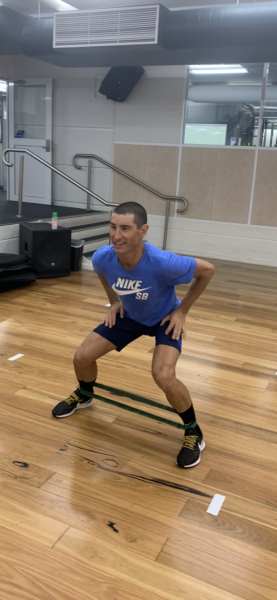
As a warm-up, the lateral walk with a resistance band around the ankles is perfect. It is an exercise that only requires a band.
Place the band around the ankles and get into a 1/2 squat position (knees at 90°), with your feet hip-width apart. Your hands rest on your chest, on your hips or they can be joined, in front of you.
Drive your right foot outward to bring your feet shoulder-width apart, then bring your left foot back to return to feet hip-width apart. Repeat 10 times to the right and 10 times to the left. This is one set. Do 3.
Side plank
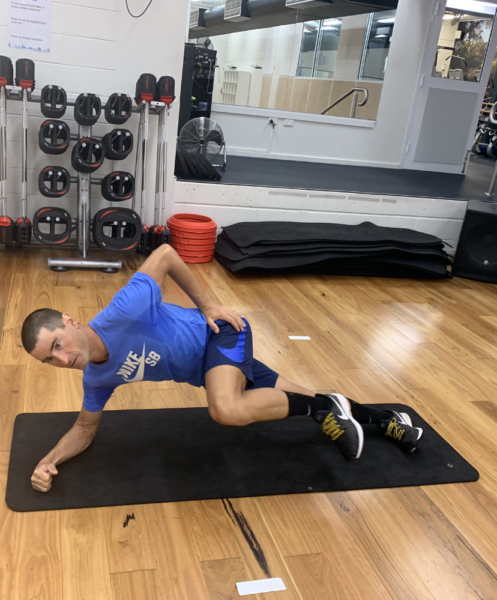
The side plank with the free leg in abduction reproducing the running movement pattern is a second very effective exercise to prepare your muscles and pre-activate them so they work at maximum on the more complete exercises that follow. This exercise requires no equipment. A mat, however, makes the exercise more comfortable.
Position yourself on your side with the elbow and forearm in contact with the floor. The outer edge of the foot is also in contact with the floor. Lift the trunk so that the shoulders, hips and ankles are aligned.
The free leg performs back-and-forth movements.
Perform this exercise for 45”, recover for the same duration. Switch sides and repeat. This is one set. Do two.
Deadlift variation
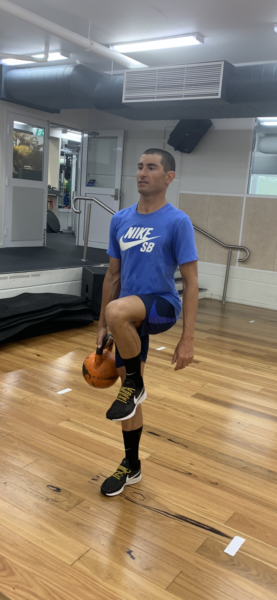
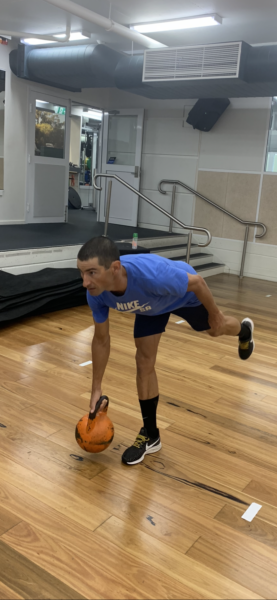
Another exercise that recruits many muscles around the hips is a deadlift variation.
With a kettlebell, stand upright. The exercise consists of lowering the trunk forward and at the same time lifting the leg opposite the kettlebell. Come back up with the leg performing a knee raise. Perform 20 repetitions for each leg. This is one set. Do two.
You can obviously do this exercise with a dumbbell. You can adjust the weight according to your abilities. In addition to strengthening the glute muscles and hip stabilisers, it is an exercise that increases your plantar proprioception. Perfect to improve balance.
Hex bar deadlift
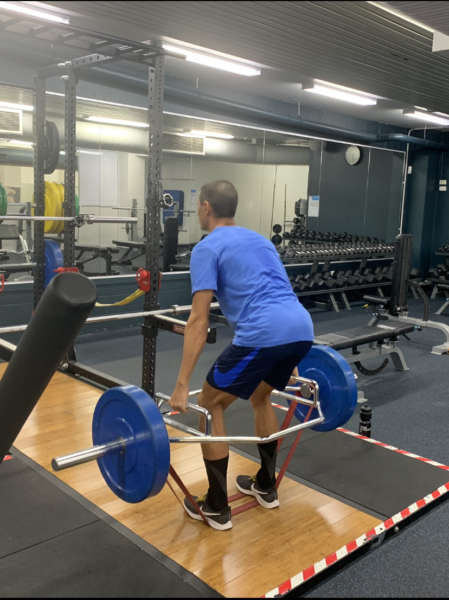
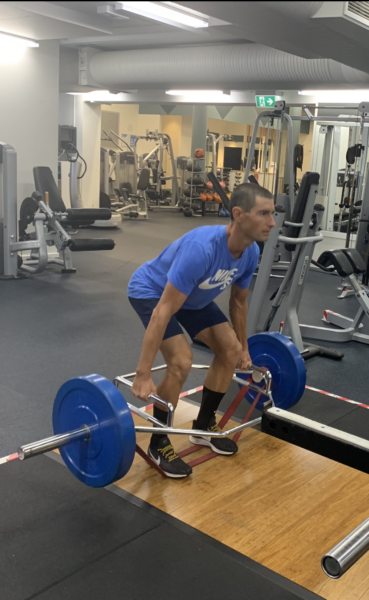
The hex bar deadlift is another exercise that targets the glutes and hamstrings.
The main advantage of the hex bar is that it distributes the load differently from the traditional bar, aligning it with your body and putting more weight on your knees and less on your lower back.
To work more intensely through the full movement path, you can add a band that will increase the workload as you stand up.
You can also vary the hex bar deadlift with band by placing one foot forward on one band loop and the other foot back on the other loop to perform lunges rather than deadlifts.
You must make sure to keep the hips level and, as with all suggested exercises, the knees must stay aligned with the ankles and/or shoulders.
You need 10 repetitions for each side. This is one set that you do twice.
Start with very light loads. You can also vary the band tension.
Single-leg Bulgarian squats
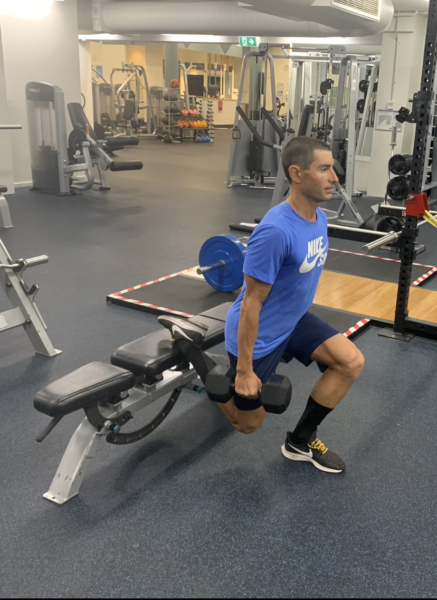
Single-leg Bulgarian squats are a safe and accessible way to develop lower-body strength and correct imbalances while improving mobility and total-body stability.
The Bulgarian Split Squat is so accessible that it does not require much weight to be loaded effectively. This not only removes stress from the spine but also reduces injury risk. It is an excellent exercise when you do not have access to a gym…
This is a unilateral exercise, like the locomotion pattern of running. Unilateral training with the Bulgarian split squat is an excellent way to correct these imbalances and bring weak points to light.
Rather than trying to strengthen the weaker leg with heavier weights, a smarter approach is to train both legs the same way, but individually. It is always a good idea to work your weak side first when you do Bulgarian squats. Any single-leg exercise has the added benefit of improving stability.
Preventing the body from rotating and maintaining good posture throughout the movement will put extra demand on the stabiliser muscles.
With Bulgarian squats, while the front leg is technically the one working, the back leg is still able to support and assist in the movement.
You can also increase or decrease the stability factor by using different tools. Using a Kettlebell or a Barbell Front Rack, a Zercher Hold or a Single-Arm Hold will make stabilisation during the Bulgarian Split Squat much more difficult. Conversely, dumbbells / kettlebells in each hand or simply your bodyweight will be easier.
10 repetitions on each leg make one set. Perform 3 sets.
Band hip extensions
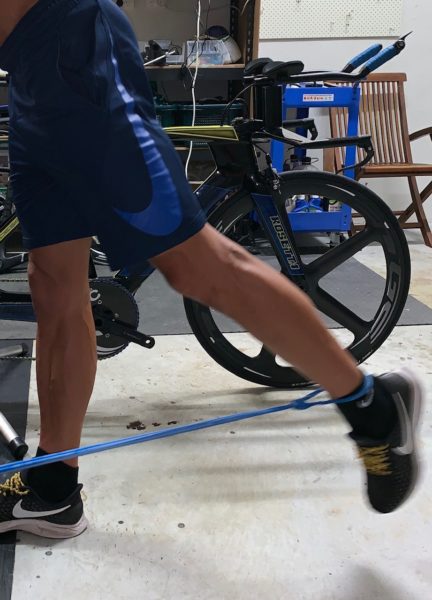
Band hip extensions target the glute muscles. In the background, the thigh muscle groups also work. This is especially the case for the hamstrings.
For this exercise, a small resistance band is needed. Also, move a support close to you to keep your balance when you perform the movement. Make sure you have a sufficiently large area for your safety.
Otherwise, you can use a long band. However, you need a low support to attach the end of the band. The greater the band resistance, the greater the difficulty of the exercise.
To start, attach the band to a support (long band) and to your ankle or to both ankles (small band). Feet width equal to hip width.
Move the leg backward. Your leg must remain straight throughout the movement. The other leg must not move. Always exhale during the concentric contraction…
Return to the starting position by doing the reverse movement without bending the leg. Also, control the band resistance.
You can also perform the band hip extension in a quadruped position. This provides the same benefits but you must, however, have a small band.
To do this, attach the band to both ankles. Then extend the working leg.
Do 10 repetitions for each leg. This is one set. 3 sets are sufficient.
Jump rope
Jump rope is an easy-to-access physical activity, requiring minimal space and incredibly inexpensive. It engages and develops the muscles of the arms and legs, improves aerobic capacity, cardiovascular function, metabolism and sense of balance.
Jump rope is a way to strengthen the thigh muscles, the glute muscles, the abdominals, the adductors and the calves. Each area can be specifically trained through variations and more complex movements.
Regulars can use weighted ankle straps to make the practice more complex and increase muscular workload.
The exercise can last from 5 to 25′ by alternating work and recovery intervals.
The way of jumping can also vary the difficulty and avoid monotony (one-foot jump, feet-together jump, bent-knee feet-together jump).
