
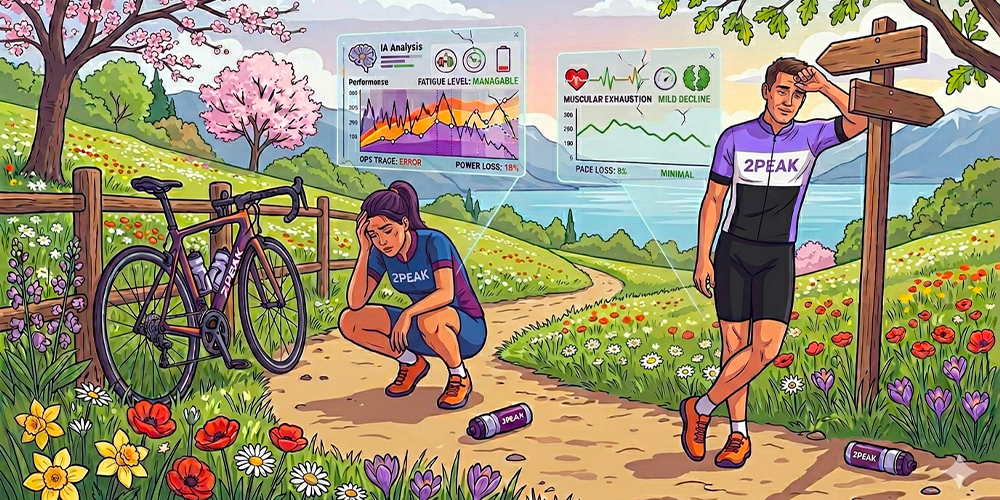
Every spring, from mid-March to mid-April, many athletes experience the same contradiction: the competition season is starting, but the body hasn’t caught up yet. For a triathlete, cyclist, or runner in full preparation, this seasonal dip rarely comes at a good time.
Why do we feel this fatigue?
Spring fatigue occurs mainly in regions where light and temperature conditions vary significantly across seasons. It is not an illness, but a perfectly normal side effect of the body adapting to longer, warmer days.
In winter, the body protects itself from cold and darkness by slightly lowering its internal temperature, raising blood pressure, and producing more melatonin, the sleep hormone. As soon as the sun becomes more generous, the metabolism must readjust: increasing UV radiation gradually reduces melatonin production in favour of serotonin, the well-being hormone. This hormonal rebalancing takes time — and it is precisely during this transition that fatigue is felt most strongly.
The late-March clock change: a mini jet-lag for your performance
The switch to daylight saving time, every last Sunday in March, adds to this already delicate transition period. By moving the clocks forward one hour, we lose sixty minutes of sleep in a single night — a disruption that may seem minor, but whose effects can last several days.
Our biological clock (the circadian rhythm) is synchronised to natural light. The clock change creates an artificial gap between our internal clock and social time, similar to a one-hour eastward jet-lag. Falling asleep and waking up becomes more difficult, the quality of deep sleep decreases, and nighttime awakenings may increase.
What this means in practice for training: the morning session will be shifted away from the circadian performance peak, activation levels will be lower, and post-exercise recovery less efficient. Chronobiologists at the University of Birmingham have shown that individual performance can vary by up to 26% depending on the time of day — which means being shifted one hour out of your usual rhythm is far from trivial.
Impact on athletic performance: what the research says
Sleep is not a luxury for an endurance athlete. It is a training component in its own right.
Endurance and VO2max. Studies on endurance sports show that sleep extension helps maintain aerobic performance more effectively than normal or restricted sleep, thanks to better muscle recovery and more efficient management of physical stress.
Reaction time and coordination. Seven consecutive nights at five hours of sleep reduce reaction time by 23%, and seven nights at seven hours reduce it by 12%, compared to nine-hour nights. For a cyclist in a peloton or a triathlete on the road, dulled reflexes also represent a safety risk (Sargent et al.)
Muscle strength and recovery. Partial sleep restriction affects strength, power, and muscular endurance, as well as motor skills under high cognitive load. The injury risk also increases significantly: athletes who sleep fewer than eight hours per night are 1.7 times more likely to get injured than those who sleep more (Randell et al.).
Motivation and perceived effort. A poor night’s sleep doesn’t just slow down the legs — it weighs on the mind too. Research shows that partial sleep deprivation is associated with a decline in mood and a higher rating of perceived exertion (RPE) at the same intensity. The result: sessions feel subjectively harder, adherence to the training plan erodes, and the motivation to head out in cool weather is the first thing to disappear.
Practical strategies for the athlete
Prepare for the clock change gradually. In the two or three days before the switch to daylight saving time, progressively shift bedtime and wake-up time by fifteen to twenty minutes each day. This follows the same logic as anticipating jet-lag before a competition abroad.
Make the most of morning light. Exposing yourself to natural light as soon as you wake up is the most powerful signal for quickly resetting the circadian rhythm. Ideally, incorporate low-intensity endurance sessions in the morning during this transition period — they serve both training and resynchronisation purposes.
Protect the nocturnal recovery window. Avoid screens in the hour before bed, limit caffeine after 2 pm, and keep the bedroom cool (around 18–20°C). Extending sleep duration remains the most effective intervention for improving athlete performance, ahead of napping and sleep hygiene measures.
The strategic nap. A ten to twenty-minute nap between 1 pm and 3 pm can compensate for the sleep deficit from the clock-change night without disrupting the evening bedtime. Beyond twenty minutes, you enter a deep sleep cycle and waking up becomes counterproductive.
Adapt your training. The week of the clock change is not ideal for scheduling a maximum load session or a performance test. Favour moderate-intensity volumes, and postpone high-intensity blocks to the following week, once the circadian rhythm has stabilised.
Spring nutritional allies
A balanced diet supports the metabolism during transition. Prioritise foods rich in tryptophan — a precursor to serotonin — such as legumes, nuts, and eggs. Seasonal green vegetables (spinach, asparagus) provide the micronutrients needed for cellular energy production. During periods of spring fatigue, iron and magnesium requirements deserve particular attention, especially in runners subject to plantar haemolysis.
In summary
Spring fatigue and the clock change form a double obstacle that arrives precisely when the competition season is picking up pace. But with proactive sleep management, sensible light exposure, and a few training adjustments, adaptation generally takes one to two weeks — making way for the energy and performances that are characteristic of spring.