Categories
Health Nutrition

Hydration in hot weather: how much, what and when to drink

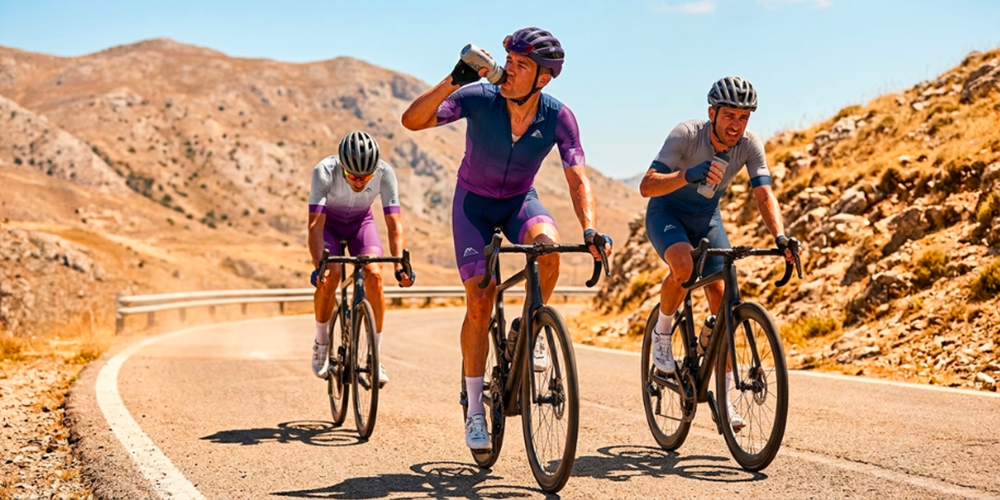
Temperatures are hitting record highs, and training under the full sun has become a real challenge: you need to manage the situation carefully to avoid hitting the wall mid-session. One of the variables that matters most is how much and what you drink — this article shows you how to get it right.

In the heat, you sweat more and lose more fluid: nothing new there. But there’s a less obvious cost: your body ends up working on two fronts at once, since it has to fuel the muscles while also sending blood to the skin to cool you down. It’s a bit like spending double the energy to hold the same pace, which means fatigue sets in earlier.

The fact is, beyond a certain threshold, dehydration doesn’t just make you less efficient — it actually slows you down. The reference review from the American College of Sports Medicine (Sawka et al., 2007, Medicine & Science in Sports & Exercise) shows that losing just over about 2% of body weight is enough to impair aerobic endurance. For a 70 kg athlete, that’s a little more than 1.4 litres — an amount you can lose without even noticing during an hour in strong heat. That’s why, in summer, hydration stops being a minor detail and becomes part of the training itself.

How much water do you actually need (and why “as much as possible” is the wrong answer)

There’s no single number that works for everyone, and anyone who gives you one is oversimplifying. How much you sweat and what your sweat contains vary enormously from person to person: Baker’s review (2017, Sports Medicine) reports sweat rates ranging from about 0.5 to 2 litres per hour and sweat sodium concentrations between 10 and 90 mmol/L. In other words, two athletes running side by side, at the same pace and in the same weather, can have fluid needs that differ by a factor of three to four.

The simplest way to find your own number is to weigh yourself before and after a one-hour session under your usual conditions, accounting for anything you drank in between. Each kilogram lost corresponds to roughly one litre of fluid: this way, you stop relying on guesswork and build yourself a personal benchmark — the only one that really matters.

For some concrete reference points:

  • Running. On a long summer run, an average-sized runner often sweats 1 to 1.5 litres per hour. You can’t (and shouldn’t try to) replace all of it while running, but small sips every 15–20 minutes, roughly 0.4 to 0.8 litres per hour, keep losses within a healthy range. On a run of two hours or more, that means planning for at least one to one and a half litres in total, whether via bottle, hydration belt, or fountains along the route.
  • Cycling. This is easier, since you have bottles on the frame: 500 to 750 ml per hour is the classic benchmark for long rides in hot weather, pushing toward the upper end of that range when the sun is strong and intensity rises.

These numbers are a starting point, not a fixed rule: cross-check them against your thirst and your before/after weight, and adjust accordingly.

And here’s the counterintuitive part: drinking too much is just as dangerous as drinking too little. If you take in more fluid than you lose, the sodium in your blood becomes diluted and hyponatremia can occur — an excessive drop in plasma sodium that, in severe cases, becomes a genuine medical emergency. It’s no coincidence that the international consensus conference on the topic (Hew-Butler et al., 2015, Clinical Journal of Sport Medicine) specifically warns against this kind of excess: pushing fluids “as much as possible” is just as much a mistake as drinking too little.

That said, the most common mistake in hot weather is the opposite: waiting until you feel thirsty. By the time thirst kicks in, you’re already behind on what you’ve lost, and it’s too late to comfortably catch up on the go. It’s better to plan ahead: drink small amounts often right from the start, in regular small sips, spreading the litres you estimated from weighing yourself across the whole session. On very long, very hot sessions beyond two or three hours, a real hydration plan becomes almost essential.

Salt matters as much as water

Through sweat, you don’t just lose water — you also lose salts, and sodium is by far the main one. For a short session, plain water works perfectly well. But once you go well past an hour and sweat heavily, rehydrating with water alone becomes counterproductive: it dilutes what sodium you have left even further, pushing you closer to that zone of cramps, heavy-headedness, and dropping power numbers.

Sodium, in fact, isn’t just there to “replace what’s lost.” It helps the body retain the fluid you drink instead of flushing it out right away, and it keeps thirst active, so you keep hydrating regularly instead of stopping too soon. How much you need, again, depends on you: in Baker’s study, sweat sodium concentration ranges from 10 to 90 mmol/L — a huge spread. The practical rule is simple: on long, hot sessions, don’t rely on water alone — use an electrolyte drink or add a pinch of salt to what you eat and drink.

In practice

  • Weigh yourself before and after a typical session: each kilogram lost ≈ 1 litre to replace.
  • Don’t wait for thirst: drink small amounts often right from the start. As a rough guide for long sessions: ~0.4–0.8 L/h running and 500–750 ml per hour on the bike.
  • Past about an hour of heavy sweating, add sodium and electrolytes, not just water.
  • For sessions over 2–3 hours in hot weather, plan water and fuelling in advance.


Sources

  • Sawka MN, Burke LM, Eichner ER, Maughan RJ, Montain SJ, Stachenfeld NS (2007). American College of Sports Medicine position stand. Exercise and fluid replacement. Medicine & Science in Sports & Exercise, 39(2):377–390. — Dehydration of > ~2% of body weight impairs aerobic endurance.
  • Baker LB (2017). Sweating Rate and Sweat Sodium Concentration in Athletes: A Review of Methodology and Intra/Interindividual Variability. Sports Medicine, 47(Suppl 1):111–128. — Sweat rates ~0.5–2 L/h and sweat sodium 10–90 mmol/L, with wide individual variability.
  • Hew-Butler T, Rosner MH, Fowkes-Godek S, et al. (2015). Statement of the 3rd International Exercise-Associated Hyponatremia Consensus Development Conference, Carlsbad, California, 2015. Clinical Journal of Sport Medicine, 25(4):303–320. — Overdrinking beyond thirst is the leading cause of exercise-associated hyponatremia.
Categories
Health

Summer training: how do you get your body used to the heat?

The first summer rides always feel harder than expected. The legs are there, the lungs too — yet heart rate spikes, pace drops, and after half an hour you feel completely drained.

It’s not a fitness issue. It’s that your body has never been trained to work under thermal stress. The good news is that this feeling is temporary. With about two weeks of gradual exposure — and a few practical adjustments — the body adapts remarkably well.

What happens to the body in the heat

When you train in high temperatures, your cardiovascular system has to do two things at once: deliver blood to the working muscles, and deliver blood to the skin to dissipate heat. These two demands compete for the same resources, and the result is that heart rate rises even though the effort level is the same as usual.

At the same time, core body temperature rises more quickly than during a session in cool conditions. The body, to protect itself, starts slowing you down before you even notice — this is a safety mechanism, not a weakness. For many athletes not yet accustomed to summer heat, sustainable power output drops by 10–15% compared to cooler days.

The body adapts — and does so quickly

The interesting part is that just a few weeks of regular training in the heat are enough for the body to adapt significantly. Science has documented these changes with considerable precision: plasma volume — the liquid portion of the blood — increases by an average of 6–12% after a period of heat exposure (Carr et al., 2019, Frontiers in Physiology). This means the heart can pump more blood per beat, and the body no longer has to choose between cooling the skin and fuelling the muscles — it can do both better.

Other adaptations you’ll notice over time: sweating begins earlier and becomes more abundant, heart rate at the same effort level drops, and the sense of fatigue diminishes. It doesn’t mean heat stops being hot — but your body becomes much more efficient at managing it (Racinais et al., 2015, British Journal of Sports Medicine).

Most of these adaptations occur within the first 10–14 days of regular exposure. In practice, if you start the summer season by training consistently and not skipping sessions to “avoid the heat,” the process happens on its own — no special protocols needed.

How to adapt intelligently

The key is gradualness. There is no safe shortcut to speed up adaptation. In the first two summer weeks, don’t look at watts or pace — focus on how you feel and how your heart rate responds. If your normal pace puts you at 150 bpm in spring, expect to be at 160–165 at the same perceived intensities until the body has adapted. That’s normal. Resisting the temptation to push harder is the smartest choice.

If you have a quality session planned — intervals, threshold work, a demanding long ride — move it to the cooler hours of the day, where you perform better and recover faster. Easy sessions, on the other hand, are the right moment to expose yourself to the heat: that’s where adaptation happens, without compromising training quality.

Those who want to accelerate the process can use deliberate heat acclimatisation sessions: 60–90 minute rides or workouts during the hottest hours of the day at moderate intensity. The goal is not performance, but prolonged exposure to thermal stress — enough to send the body a clear signal without fully depleting it. It’s not mandatory, but can be useful if you have little time before a race in a hot environment or want to compress the adaptation timeline.

Note: these sessions should be approached with caution. Start with shorter exposures, never train alone in extreme heat, and stop if you experience headache, nausea, or dizziness.

Hydration becomes more critical than you might think. In the heat, you can lose between 0.5 and 2 litres of water per hour depending on intensity and temperature. A simple signal to watch: urine colour. Pale straw yellow means you’re well hydrated; dark yellow means you’re building up a deficit. Drink before you’re thirsty, not after.

Warning signs to watch for

Training in the heat requires a more attentive level of body awareness than in cool seasons. Unusual fatigue, headaches during or after a session, nausea, dizziness, or a sudden stop in sweating are signs that the body is struggling to regulate temperature: in these cases, stop, seek shade and cool air, rehydrate, and don’t resume until you feel well.

People with cardiovascular problems, high blood pressure, or taking medications that affect thermoregulation (certain diuretics or beta-blockers, for example) should consult their doctor before increasing training load in the warmer months.

Summer heat as a stimulus, not an obstacle

Something that surprises many athletes is learning that training in the heat doesn’t only improve performance in hot conditions. The increase in plasma volume — one of the main adaptations — also brings benefits in races held in cool conditions or at altitude, because it improves the blood’s ability to transport oxygen (Chalmers et al., 2019, Frontiers in Physiology). In other words, summer weeks, when managed well, build a solid physiological base for the entire second half of the season.


References

Racinais S. et al. (2015). Consensus recommendations on training and competing in the heat. British Journal of Sports Medicine, 49(18), 1164–1173.

Carr A.J. et al. (2019). Mixed Active and Passive, Heart Rate-Controlled Heat Acclimation Is Effective for Paralympic and Able-Bodied Triathletes. Frontiers in Physiology, 10, 1214.

Chalmers S. et al. (2019). Performance Changes Following Heat Acclimation and the Factors That Influence These Changes: Meta-Analysis and Meta-Regression. Frontiers in Physiology, 10, 1448.

Categories
Health Triathlon

Recovery: Tips and Tricks

Triathletes are well known for being training machines. The laps in the pool, the kilometres in the saddle and the strides on the tarmac soon add up — or rather, they are collected with a certain pride. It «soothes» the conscience. But this enthusiasm for effort must not give way to haste and the mistakes that come from a lack of recovery…

Categories
Health

Spring Fatigue: How to Protect Your Endurance Performance

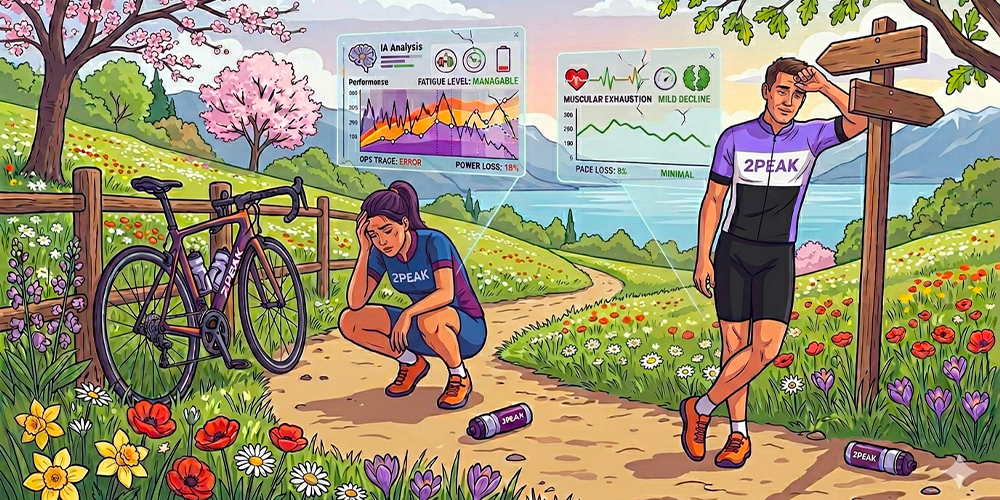
Every spring, from mid-March to mid-April, many athletes experience the same contradiction: the competition season is starting, but the body hasn’t caught up yet. For a triathlete, cyclist, or runner in full preparation, this seasonal dip rarely comes at a good time.

Categories
Health

Does training in the cold make you sick? Myths and facts

Has it ever happened to you that you go out in biting cold, nail a good session, and then the next day your throat feels weird or your nose starts running? In that moment the conclusion feels obvious: “I got cold, so I’m getting sick.” It’s an automatic thought because two events happen close together. The problem is we often blame the wrong culprit. Let’s look at what science says and, more importantly, what actually makes sense in practice.

Categories
Health

5 tips to prevent tendinitis

Rare are the athletes who have never had to deal with a painful tendinitis at some point. Tendinitis is an inflammation of the tendon, the fibrous structure that connects muscle to bone. It is mainly caused by excessive muscular stress or by unsuitable equipment. In this latter case we speak of technopathy, since it is the equipment that causes the issue.

Categories
Health

Sleep – the secret fuel of athletes

In humans, periods of sleep invariably follow periods of wakefulness according to a circadian rhythm (day/night alternation), partly dictated by our internal clock but also influenced by environmental stimuli (light, noise, nutrition, exercise …). But what is the impact of sleep on athletic performance?

Categories
Health Triathlon

How to Train Without Injury – The Essentials for Endurance Athletes

Injury is probably the worst issue an athlete has to deal with. Whatever its nature, it brings a season, a passion (for an amateur), or even a career (for a professional) to a sudden stop. Anticipating and preventing injuries is therefore a major goal for any athlete. Let’s explore the key aspects in this blog article.

Categories
Health

Heart Rate Variability (HRV) in Endurance Sports

An efficient cardiovascular system adapts flexibly to different levels of effort and recovery phases. A key indicator of this adaptability is heart rate variability (HRV). But what exactly does it mean, and why is it so important for endurance athletes like cyclists, runners, and swimmers?

Categories
Health

Heart Rate Fluctuations in Endurance Sports: Understanding and Utilizing Them

Heart rate naturally fluctuates in endurance sports. Sometimes it remains stable, while at other times it unexpectedly rises or falls. But why? These fluctuations are key indicators of fitness, recovery, and stress levels. Understanding and interpreting them correctly allows you to optimize training and prevent overexertion. In this article, we explore their causes, influencing factors, and how to integrate this knowledge effectively into your training.