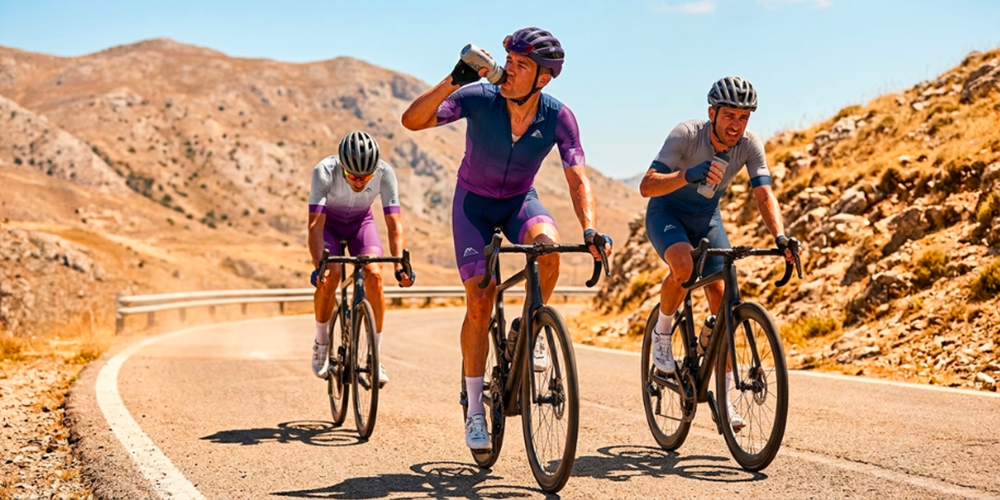
Temperatures are hitting record highs, and training under the full sun has become a real challenge: you need to manage the situation carefully to avoid hitting the wall mid-session. One of the variables that matters most is how much and what you drink — this article shows you how to get it right.
In the heat, you sweat more and lose more fluid: nothing new there. But there’s a less obvious cost: your body ends up working on two fronts at once, since it has to fuel the muscles while also sending blood to the skin to cool you down. It’s a bit like spending double the energy to hold the same pace, which means fatigue sets in earlier.
The fact is, beyond a certain threshold, dehydration doesn’t just make you less efficient — it actually slows you down. The reference review from the American College of Sports Medicine (Sawka et al., 2007, Medicine & Science in Sports & Exercise) shows that losing just over about 2% of body weight is enough to impair aerobic endurance. For a 70 kg athlete, that’s a little more than 1.4 litres — an amount you can lose without even noticing during an hour in strong heat. That’s why, in summer, hydration stops being a minor detail and becomes part of the training itself.
How much water do you actually need (and why “as much as possible” is the wrong answer)
There’s no single number that works for everyone, and anyone who gives you one is oversimplifying. How much you sweat and what your sweat contains vary enormously from person to person: Baker’s review (2017, Sports Medicine) reports sweat rates ranging from about 0.5 to 2 litres per hour and sweat sodium concentrations between 10 and 90 mmol/L. In other words, two athletes running side by side, at the same pace and in the same weather, can have fluid needs that differ by a factor of three to four.
The simplest way to find your own number is to weigh yourself before and after a one-hour session under your usual conditions, accounting for anything you drank in between. Each kilogram lost corresponds to roughly one litre of fluid: this way, you stop relying on guesswork and build yourself a personal benchmark — the only one that really matters.
For some concrete reference points:
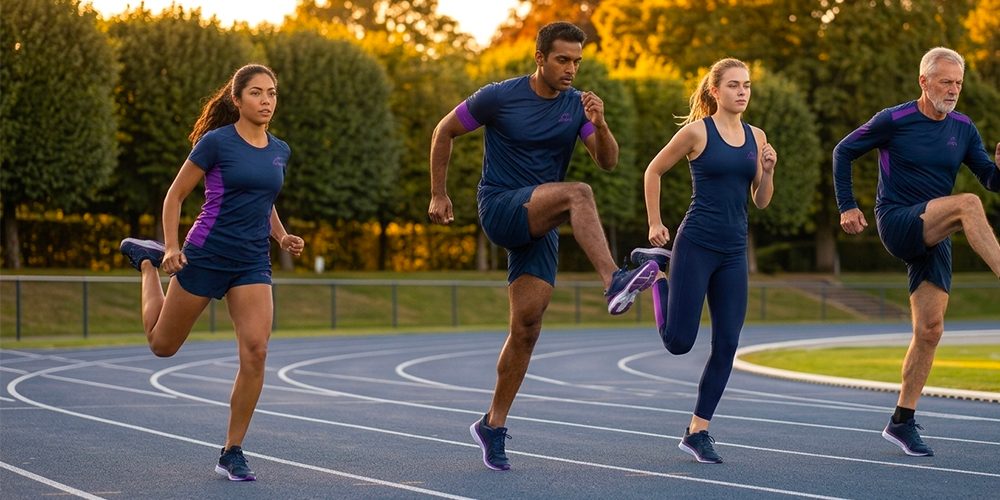
- Running. On a long summer run, an average-sized runner often sweats 1 to 1.5 litres per hour. You can’t (and shouldn’t try to) replace all of it while running, but small sips every 15–20 minutes, roughly 0.4 to 0.8 litres per hour, keep losses within a healthy range. On a run of two hours or more, that means planning for at least one to one and a half litres in total, whether via bottle, hydration belt, or fountains along the route.
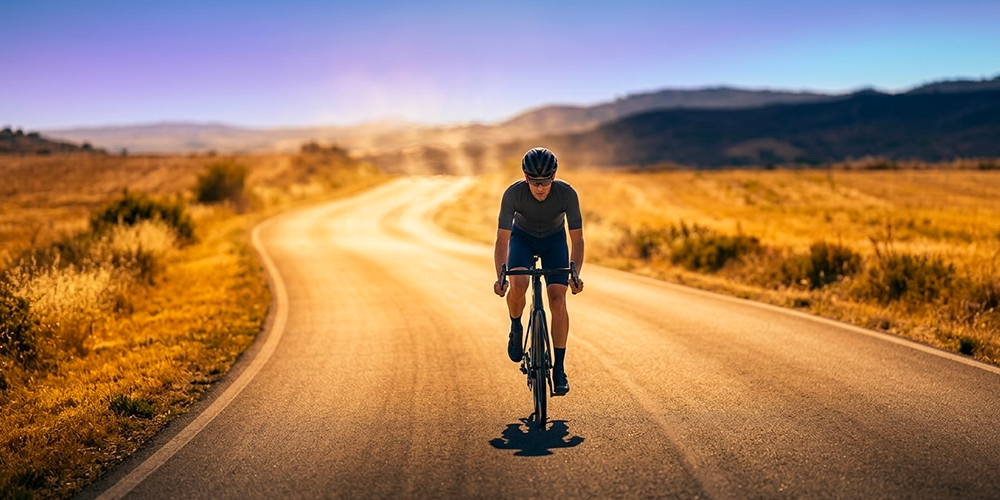
- Cycling. This is easier, since you have bottles on the frame: 500 to 750 ml per hour is the classic benchmark for long rides in hot weather, pushing toward the upper end of that range when the sun is strong and intensity rises.
These numbers are a starting point, not a fixed rule: cross-check them against your thirst and your before/after weight, and adjust accordingly.
And here’s the counterintuitive part: drinking too much is just as dangerous as drinking too little. If you take in more fluid than you lose, the sodium in your blood becomes diluted and hyponatremia can occur — an excessive drop in plasma sodium that, in severe cases, becomes a genuine medical emergency. It’s no coincidence that the international consensus conference on the topic (Hew-Butler et al., 2015, Clinical Journal of Sport Medicine) specifically warns against this kind of excess: pushing fluids “as much as possible” is just as much a mistake as drinking too little.
That said, the most common mistake in hot weather is the opposite: waiting until you feel thirsty. By the time thirst kicks in, you’re already behind on what you’ve lost, and it’s too late to comfortably catch up on the go. It’s better to plan ahead: drink small amounts often right from the start, in regular small sips, spreading the litres you estimated from weighing yourself across the whole session. On very long, very hot sessions beyond two or three hours, a real hydration plan becomes almost essential.
Salt matters as much as water
Through sweat, you don’t just lose water — you also lose salts, and sodium is by far the main one. For a short session, plain water works perfectly well. But once you go well past an hour and sweat heavily, rehydrating with water alone becomes counterproductive: it dilutes what sodium you have left even further, pushing you closer to that zone of cramps, heavy-headedness, and dropping power numbers.
Sodium, in fact, isn’t just there to “replace what’s lost.” It helps the body retain the fluid you drink instead of flushing it out right away, and it keeps thirst active, so you keep hydrating regularly instead of stopping too soon. How much you need, again, depends on you: in Baker’s study, sweat sodium concentration ranges from 10 to 90 mmol/L — a huge spread. The practical rule is simple: on long, hot sessions, don’t rely on water alone — use an electrolyte drink or add a pinch of salt to what you eat and drink.
In practice
- Weigh yourself before and after a typical session: each kilogram lost ≈ 1 litre to replace.
- Don’t wait for thirst: drink small amounts often right from the start. As a rough guide for long sessions: ~0.4–0.8 L/h running and 500–750 ml per hour on the bike.
- Past about an hour of heavy sweating, add sodium and electrolytes, not just water.
- For sessions over 2–3 hours in hot weather, plan water and fuelling in advance.
Sources
- Sawka MN, Burke LM, Eichner ER, Maughan RJ, Montain SJ, Stachenfeld NS (2007). American College of Sports Medicine position stand. Exercise and fluid replacement. Medicine & Science in Sports & Exercise, 39(2):377–390. — Dehydration of > ~2% of body weight impairs aerobic endurance.
- Baker LB (2017). Sweating Rate and Sweat Sodium Concentration in Athletes: A Review of Methodology and Intra/Interindividual Variability. Sports Medicine, 47(Suppl 1):111–128. — Sweat rates ~0.5–2 L/h and sweat sodium 10–90 mmol/L, with wide individual variability.
- Hew-Butler T, Rosner MH, Fowkes-Godek S, et al. (2015). Statement of the 3rd International Exercise-Associated Hyponatremia Consensus Development Conference, Carlsbad, California, 2015. Clinical Journal of Sport Medicine, 25(4):303–320. — Overdrinking beyond thirst is the leading cause of exercise-associated hyponatremia.