
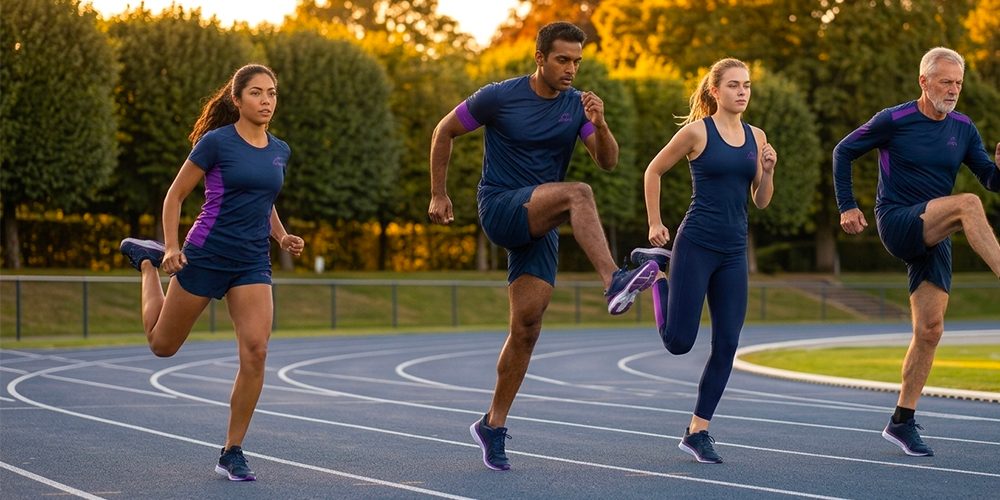
When you run, you mostly think about your weekly mileage, your shoes, and how hard your sessions are. Technique, on the other hand, often takes a back seat – and it’s true that it largely refines itself over time. Still, some movement patterns are worth a closer look: they can stick around for years and cost you a bit of energy with every stride. Here are seven details worth examining – along with some scientific background to help explain why.
Does technique really make a difference?
It all comes down to running economy: the oxygen you spend to hold a given pace. At equal aerobic capacity, the runner with better economy covers more ground for the same effort. Barnes and Kilding (Sports Medicine Open, 2015) found that two well-trained runners with comparable VO₂max can differ in running economy by as much as 30%.
1. Cadence – how many steps do you take per minute?
Step frequency (cadence) is the number of foot strikes you make per minute. Most recreational runners fall between 150 and 170 steps per minute, while elite runners often exceed 180. Claiming that 180 is the perfect number for everyone would be an oversimplification. On one point, though, the research is clear: increasing your cadence relative to your habitual rate reduces the load on your joints.
In a study by Heiderscheit et al. (Medicine & Science in Sports & Exercise, 2011), 45 people ran on a treadmill. When cadence was increased by 10% above their spontaneous rate, energy absorption at the knee dropped by 34%. The mechanism is straightforward: the stride shortens, the foot lands closer to the centre of mass, and the forces absorbed decrease.
The opposite pattern has a name: overstriding. The foot lands too far ahead of you, the knee is nearly straight, and every footstrike brakes your forward motion. If your stride feels long and “bouncy,” adjusting your cadence is one of the best-documented ways to fix it.
2. Foot strike – heel, midfoot, or forefoot?
Where your foot first touches the ground changes how forces are distributed across the knee, ankle, and Achilles tendon. So whether you land on your heel, midfoot, or forefoot isn’t a trivial detail. No single style is universally “correct”: forefoot striking favours speed and elastic energy return, midfoot striking distributes load more evenly and suits long distances well, and heel striking – the most common pattern among recreational runners – places less strain on the calves. That said, switching styles needs to be gradual: changing your foot strike too quickly is one of the most common causes of tendon injuries.
3. Leg recovery – what does your leg do after push-off?
Once the foot leaves the ground, the leg has to swing forward again to prepare for the next footstrike. How this recovery happens affects the overall efficiency of the movement. The most economical runners pull the heel up compactly toward the glutes – the well-known “high heel recovery” – before driving the leg forward. By contrast, keeping the leg low, to the point where the foot nearly skims the ground during recovery, lengthens the path and wastes energy.
An inefficient leg recovery shows up as a heavy, “flat” stride with no real lightness in the flight phase. This is exactly where running drills come in, particularly heel flicks: they train the body to bring the leg back automatically and compactly, so the energy goes into forward motion instead of being wasted.
4. Hips and glutes – are you engaging the right muscles?
When running, it’s mainly the quadriceps and calf muscles that get activated. Hip extension, on the other hand, sometimes stays in the background, even though it’s one of the main drivers of propulsion. The glute max and hamstrings contribute substantially to push-off, and their contribution grows with pace.
Dorn, Schache, and Pandy (Journal of Experimental Biology, 2012) showed that at higher speeds, the glute max becomes one of the most heavily used muscles: it more strongly accelerates the hip and knee during the swing phase, feeding into propulsion. For recreational runners, the practical question is simple: after a run, do you barely feel your glutes but feel your quads a lot? That may be a sign the muscular workload could be better distributed.
Sometimes it’s enough to simply think about it while running: consciously focusing your attention on pushing off through the glutes often activates them more, without changing anything else about your training. For a more structured approach, glute activation and hip extension exercises – whether in the gym or as part of your running drills – help anchor this pattern over time.
5. Posture – upright or leaning forward?
An overall upright posture, with a slight lean coming from the ankles rather than the hips, lets gravity help with propulsion. Leaning the torso too far forward, on the other hand, changes muscle activation patterns and places more load on the hips.
Teng and Powers (Medicine & Science in Sports & Exercise, 2015) compared runners with a pronounced forward lean to those with little lean: runners leaning at about 11° produced 140% more positive work at the hip than more upright runners. That’s not inherently “wrong” – at high speeds it can even take load off the knee. But it confirms that posture has a real effect on muscular economy.
One concrete point: head position. Your gaze should stay straight ahead, ten to twenty metres out, never down. Looking at your feet creates tension in the neck and shoulders – wasted energy over time.
6. Arms – what role do they actually play in running?
Your arms don’t push you forward: they counterbalance the angular momentum of your legs. When your right leg swings forward, your left arm swings forward too. This balance limits unwanted rotation of the torso and lets the legs work with fewer losses. Arellano and Kram (Journal of Experimental Biology, 2014) measured the metabolic cost of running with the arms restrained: depending on the position, oxygen consumption rose by 3 to 13% compared to normal arm swing – the worst being hands held on top of the head.
In practice:
- Elbows at around 90°, neither too open nor too closed
- Movement parallel to your direction of travel – arms shouldn’t cross in front of the chest, or energy is lost sideways
- Relaxed hands, as if you were holding a raw egg
- Low, relaxed shoulders – a tense shoulder is energy spent in the wrong place
- Speed up your arms to speed up your stride: it’s almost impossible to swing your arms faster than your legs move, so consciously speeding up your arm rhythm is one of the most immediate ways to increase your cadence
7. Vertical oscillation – are you bouncing too much?
With every footstrike, your centre of mass rises and falls slightly. Part of this movement is normal: it comes from the mechanism that stores and releases elastic energy in the tendons. The problem only arises when the bounce becomes too pronounced, since the energy then goes upward instead of forward.
If your watch tracks this metric, the average sits between 8 and 10 centimetres per step. Take it with a grain of salt, though, since pace, height, and incline all influence it – it’s better to track the trend over time than to fixate on a single number.
To work on it, start by shifting your centre of mass forward and aiming your foot strike toward the midfoot. A more “forward-oriented” stride naturally reduces bounce and makes better use of elastic energy. A higher cadence helps too: more steps means less time in the air and less vertical oscillation. And, as always: gradually.
How can you improve your technique?
Working on your technique only makes sense if you do it gradually: movement patterns change slowly, and tendons and fascia adapt even more slowly. Trying to fix too many things at once, or changing your foot strike overnight, increases the risk of overuse injuries.
It’s better to focus on one element at a time, in short segments during training. Generally, 5 to 10 minutes of technique focus at the end of your warm-up is enough. Running drills remain the go-to tool for developing neuromuscular control of each movement. Build them into your sessions regularly and keep working on them throughout your 2PEAK training plan – coordination, too, can be trained and pays off in the long run.
Sources
- Barnes, K. R., & Kilding, A. E. (2015). Running economy: measurement, norms, and determining factors. Sports Medicine Open, 1(8).
- Heiderscheit, B. C., Chumanov, E. S., Michalski, M. P., Wille, C. M., & Ryan, M. B. (2011). Effects of step rate manipulation on joint mechanics during running. Medicine & Science in Sports & Exercise, 43(2), 296–302.
- Dorn, T. S., Schache, A. G., & Pandy, M. G. (2012). Muscular strategy shift in human running: dependence of running speed on hip and ankle muscle performance. Journal of Experimental Biology, 215(11), 1944–1956.
- Teng, H. L., & Powers, C. M. (2015). Influence of trunk posture on lower extremity energetics during running. Medicine & Science in Sports & Exercise, 47(3), 625–630.
- Arellano, C. J., & Kram, R. (2014). The metabolic cost of human running: is swinging the arms worth it? Journal of Experimental Biology, 217(14), 2456–2461.