
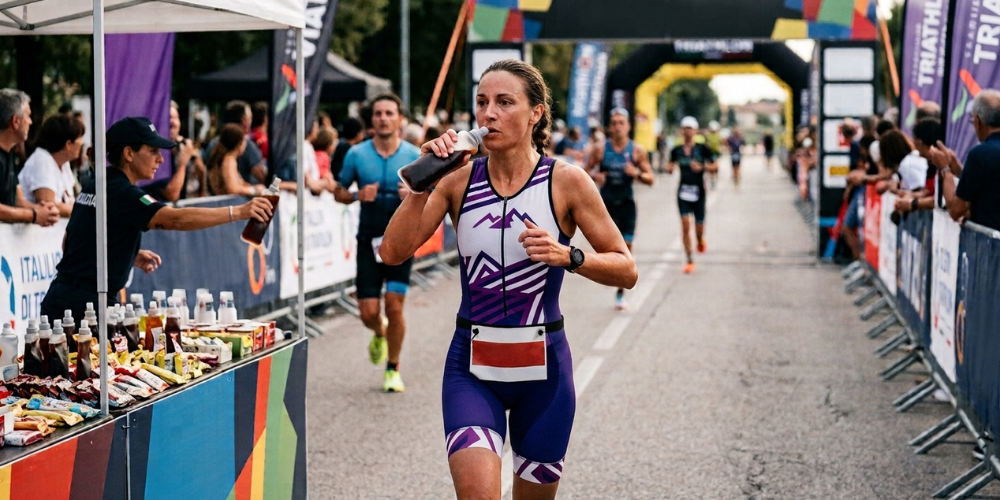
Caffeine is such a fixture of the endurance-sports landscape that we almost forget it’s an active substance. A strong espresso before the start, a gel tucked into your pocket, a last swig of cola in the closing kilometres… Yet it’s one of the oldest and most widespread stimulants in the world — you’ll find it in coffee, tea and chocolate, and you often take it without even thinking about it. Until the end of 2003 it was actually on the anti-doping list; today, there are no restrictions at all. Which leaves the real question: does it genuinely help you go faster, or is it mostly a matter of habit and ritual? Let’s look at what the science says — and above all, how to use it intelligently on race day.
What caffeine actually does to your body
Caffeine works first and foremost on the central nervous system. In practice, it makes you more alert, lifts your mood and — here’s where it gets interesting for you — it lowers your perception of effort, fatigue and pain. You don’t magically become stronger or more enduring: it’s the effort that feels more bearable, which often lets you hold a slightly higher pace without feeling like you’re working any harder.
It also has effects on the metabolic side: it promotes the use of fat as fuel, improves energy availability and acts directly on the muscle cell. It even helps with carbohydrate absorption, which is handy when you’re fuelling during a race.
The benefits are best documented for four types of effort: endurance lasting more than 20 minutes, intense efforts of 1 to 20 minutes, high-intensity interval work and maximal-strength efforts. In other words, whether you’re a runner, a cyclist or a triathlete, there’s a good chance your type of effort is on that list.
What dose should you aim for?
Good news: you don’t need to down huge amounts. An effect is likely from as little as 1 to 6 mg per kilo of body weight, and from around 3 mg/kg you hit a plateau — beyond that, the effect no longer really increases, while the downsides start to show up.
The “standard” dose sits around 3 mg/kg. For a 70 kg athlete, that’s about 210 mg, or roughly two espressos or three to four cups of filter coffee. Nothing extravagant, then.
From 6 mg/kg upwards, you enter the zone where the trouble takes over: tremors, restlessness, a racing or irregular heartbeat (tachycardia), headaches, sleep problems and digestive issues mid-race — exactly the kind of thing you’d rather do without on competition day. More is not better.
Where to find caffeine
You don’t have to rely on supplements: caffeine is pretty much everywhere, in highly variable amounts. A cup of coffee contains between 50 and 150 mg depending on how it’s made; tea, more like 20 to 50 mg. A can of energy drink (250 ml) delivers around 80 mg, and a glass of cola far less — about 10 mg per decilitre, so roughly 25 mg per 250 ml. As for chocolate, a bar of dark can climb to 70 mg, versus around fifteen mg for milk chocolate.
For a more “sporty” and precise approach, there are dedicated formats: caffeine gels (about 50 mg), tablets (around 40 mg) or concentrated shots (up to 160 mg). The advantage is that you know exactly what you’re taking — handy for fine-tuning your dose.
Getting the timing right
When you take it matters almost as much as the dose. Generally, the effect kicks in about 30 minutes after ingestion, peaks around one hour (within a 30-to-90-minute window), then tapers off after two to three hours.
In practice, for a competition, aim to take it 40 to 60 minutes before the start: that puts the peak right when the real effort begins. Towards the end of the race, when your stomach can’t keep up but you need a quick lift, many people turn to cola.
A little field tip on that: during a race, cola is best drunk flat and lukewarm. The carbon dioxide bloats your stomach, and cold drinks weigh on digestion at the worst possible moment. Let it go flat and warm up a little before you pour it into your bottle — your gut will thank you.
The myth of pre-race abstinence
Here’s a stubborn belief: you supposedly need to stop caffeine for a few days before a competition to “re-sensitise” your body and amplify its effect on race day. The idea sounds logical — except it doesn’t really hold up.
A study from the University of São Paulo looked into exactly this. The researchers split trained cyclists into three groups according to their habitual caffeine intake (low, moderate, high). Each rode a roughly 30-minute time trial under three different conditions — with 6 mg/kg of caffeine, with a placebo, or with nothing — all taken one hour before the effort.
The result: caffeine improved performance in every case, by around 2.4% compared with the placebo and 3.3% compared with taking nothing, and this regardless of habitual intake. Interestingly, it was the moderate-consumption group that benefited most.
What this means for you: stopping caffeine before a race doesn’t increase the physical benefit, whether you cut it out one, two or three days ahead. At best, the withdrawal has a mental effect, a ritual side that helps you get in the zone. At worst, it’s downright counterproductive: if you’re a heavy coffee drinker, going without can leave you with headaches, nausea and energy dips right when you’d want to be at your best. In short, no need to deprive yourself.
What recent science says
Research has refined the picture in recent years, and the current consensus confirms the essentials.
The position stand of the International Society of Sports Nutrition (ISSN, 2021) — a benchmark review written by a large panel of experts — settles on an effective range of 3 to 6 mg/kg, with a minimum dose that can go as low as around 2 mg/kg, and timing of about 60 minutes before the effort. It also confirms that beyond this (around 9 mg/kg) you mostly reap side effects with no extra benefit. The gains themselves are broad and wide-ranging: they’re most consistent for aerobic endurance, but you also see them in strength, short intense efforts and sprints.
Another useful development: the “fast” forms. Caffeinated chewing gum, for example, is absorbed directly through the lining of the mouth (the buccal mucosa), so much faster than a capsule — most of it gets in within about fifteen minutes, versus 45 to 60 minutes for a capsule that first has to pass through the stomach. Effective from 3 mg/kg, taken around fifteen minutes before the effort (chewing for at least five minutes), it also causes fewer digestive upsets. A good option if you have a sensitive stomach or your effort is short.
Finally, a word on individual variability, because it’s huge. The response to caffeine varies a lot from one person to the next, and part of that difference may come down to genetics — in particular a gene called CYP1A2, which determines whether you metabolise caffeine “fast” or “slowly”. In a study on a 10 km time trial, fast metabolisers (AA genotype) improved their performance, whereas in slow metabolisers (CC genotype) a high dose actually made it worse. A word of caution, though: the evidence on this point is still mixed. See it as a possible explanation, not a hard-and-fast rule.
A few precautions
A couple of things to keep in mind. Caffeine isn’t recommended for children under 12. In Switzerland, energy drinks can’t exceed 32 mg of caffeine per 100 ml — worth knowing if you’re counting your doses.
And then there’s that individual variability again: some people can’t handle an afternoon cappuccino without losing a night’s sleep, while others drop off just fine after three evening espressos. Your tolerance isn’t your training partner’s, and that changes everything.
Conclusion: test, test, test
If there’s just one thing to take away, it’s this: always test your dose and timing in training, never on race day. Never discover a new product, a new dose or a new format in the middle of a competition.
It’s precisely because the response to caffeine is so personal — right down to your genes — that this is the most important piece of advice in the whole article. Caffeine really can help you perform better, provided you know how your body reacts to it. And only training can teach you that. Make it an ally you know inside out before you trust it on race day.
Read more
Nutrition before an Endurance Race
Modulating carbohydrate intake: why and how to do it?
Sources
Historical content from Fit for Life (Swiss magazine dedicated to fitness and endurance sports).
Guest N. et al. (2021). International Society of Sports Nutrition Position Stand: Caffeine and Exercise Performance. Journal of the International Society of Sports Nutrition, 18(1). → 3–6 mg/kg effective (from ~2 mg/kg), ~60 min before the effort; beyond ~9 mg/kg, more side effects with no added benefit; most consistent gains for aerobic endurance.
Guest N. et al. (2018). Caffeine, CYP1A2 Genotype, and Endurance Performance in Athletes. Medicine & Science in Sports & Exercise, 50(8), 1570–1578. → in a 10 km time trial, performance improved in fast metabolisers (AA) and worsened in slow metabolisers (CC) at a high dose.
Barreto G. et al. (2023). Effects of caffeine chewing gum supplementation on exercise performance: a systematic review and meta-analysis. European Journal of Sport Science, 23(5). → caffeinated chewing gum improves performance, with fast buccal absorption and fewer digestive issues.
Gonçalves L.S. et al. (2017). Dispelling the myth that habitual caffeine consumption influences the performance response to acute caffeine supplementation. Journal of Applied Physiology, 123(1). → caffeine improves performance regardless of habitual intake; prior abstinence provides no additional benefit.