
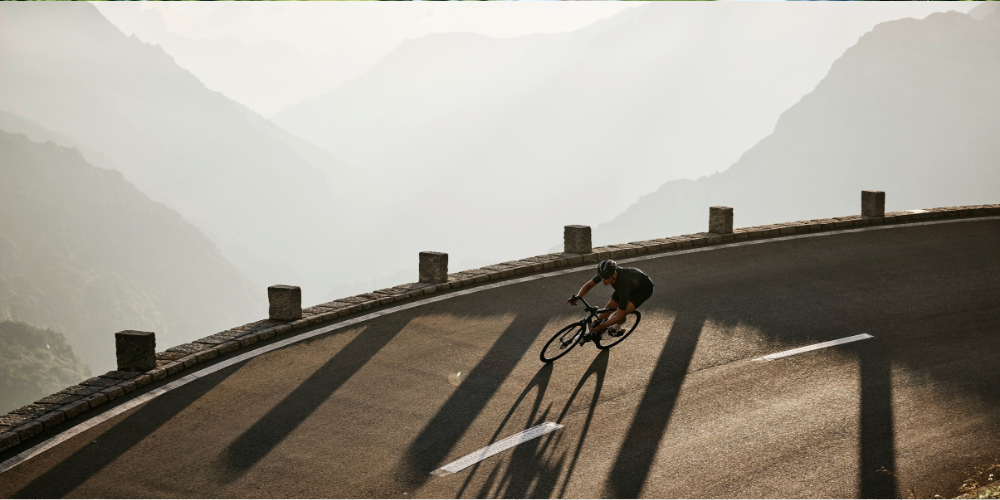
The mountains are a much-loved playground for cyclists, trail runners and triathletes in search of clean air, beautiful scenery and elevation gain. Many athletes do altitude training camps to benefit from the positive effects of altitude hypoxia and, in the long run, optimise their sporting performance.

Used for decades, this type of preparation has been extensively studied, both to prepare for competitions held at altitude (such as the Alpe d’Huez triathlon, for example) and to prepare for events held at sea level. However, performance drops at altitude, so it should be used with caution.
Why does endurance capacity decrease at altitude?
Maximum endurance capacity is reduced at altitude because of hypoxia (a drop in the concentration of oxygen in the blood). As a result, athletes have to adjust training intensity, effort management, nutrition and hydration in order to limit this drop in performance as much as possible.
It’s often said that oxygen (O2) becomes scarcer at altitude. This is only partly true. The percentage of O2 in the atmosphere actually stays constant at any altitude (20.95%). It’s only the partial pressure of O2 (PpO2) that drops, due to the reduction in barometric pressure (Pb). At sea level, the latter is 760 mmHg. At the altitude of Font Romeu (1800 m) it reaches 596 mmHg, while at the summit of Mont Blanc (4810 m) it’s no more than 430 mmHg. The drop in barometric pressure, and therefore in the partial pressure of O2, leads, through a “cascade” effect, to a reduction in the supply of O2 to the muscles.
The ultimate consequence of hypoxia is a decrease in maximal oxygen uptake (VO2max), since it depends on cardiac output and the arterio-venous O2 difference. VO2max is estimated to drop by around 9% for every 1000 m gain in altitude. Several studies have shown that this phenomenon, known as “hypoxic stress”, appears in trained individuals from as low as around 600 m. Likewise, max HR is lower at altitude, especially above 2000 m.
« Prolonged exposure to altitude leads to an increase in the number of red blood cells, which boosts the blood’s oxygen-carrying capacity. »
To limit this hypoxia, the human body puts physiological adaptations in place as soon as arterial pressure drops below its critical value. Ventilation during exercise is quickly increased to counteract the drop in SaO2 and meet the muscles’ demand for O2. This extra work by the respiratory muscles to raise breathing rate and tidal volume partly explains why, at the same relative intensity, energy expenditure is higher at 2000 m than at 1000 m. To benefit from these adaptations, a triathlete who doesn’t live at altitude year-round should, if possible, arrive a few days before the event to acclimatise. Even so, their VO2max at altitude will always remain lower than at sea level.
The physiological adaptations following an altitude camp
Acclimatisation and adaptation mechanisms are only really effective if exposure to altitude is prolonged enough, or if hypoxic training sessions are repeated. At the end of such a training block, you can then observe:
- At the muscular level: an increase in myoglobin concentration (the muscle’s oxygen stores), a densification of the capillary network (the tiny blood vessels) and an increase in the concentration of enzymes linked to aerobic metabolism.
- At the blood level: an increase in the number of red blood cells, which boosts the blood’s oxygen-carrying capacity.
The classic methods of altitude training
The first method involves medium- to long-duration stays at a medium-to-high altitude (between 1700 and 3000 m). During these periods of altitude exposure, you shouldn’t try to train intensively, or you risk “burning out”. In our view, it’s better to place these periods well away from your goals: in the off-season or at the start of specific preparation (spring). Ideally, you’d do a 1-week camp every month from November to March.
Advantages:
- Helps develop beneficial physiological adaptations
- Lets you change your environment by practising other disciplines (gravel, MTB, walking, hiking, snowshoeing, cross-country skiing…).
Disadvantages:
- Significant cost in time and money
- Acute risk of overtraining if the training load is too high.
The second method involves intermittent hypoxic training sessions in a lab. During these sessions, the athlete has to perform efforts at an intensity equal to or above the hypoxic threshold (previously determined during a fitness test) while breathing oxygen-depleted air (thereby simulating a given altitude). This method, which is very recent, is similar to a micro-camp and seems to allow very beneficial muscular adaptations to develop. The typical protocol includes 2 efforts of 12 to 20 minutes at a simulated altitude of 3000 m, at a rate of 2 sessions per week
Advantages:
- Lets you prepare without going to the mountains
Disadvantages:
- Cost
- Not specific, as it’s done in a lab
- Few centres offer this type of service.
For most amateur athletes, organising camps like these turns out to be complicated to arrange, mainly for reasons of availability and logistics. There is, however, an alternative method that lets you prepare effectively for a goal, whether it’s at altitude or at sea level.
The “shock mini-camp” method
This method involves doing one or more small training camps of 2 to 3 days at a significant altitude, between 2000 and 3000 m, during which you do substantial efforts. The aims of such a camp are twofold: to benefit from the physiological adaptations linked to exposure to high altitude and/or to train in an unusual, invigorating setting.
Advantages:
- Short camp
- Low risk of overtraining
- No break in your training cycles, unlike a long camp where respecting an adaptation phase is essential
- Breaking with your training habits
Disadvantages:
- Physiological effects presumably less pronounced compared with a long-duration altitude camp
- Logistics involved in travelling
Example programme no. 1
Goal: optimise the physiological effects on oxygen uptake
- Friday afternoon: easy recovery session after the journey, keeping your breathing comfortable. Duration: 45 minutes
- Saturday morning: MAS work including 5 x (30 sec. at 110% MAS / 30 sec. active recovery walking) then 5 x (45 sec. at 110% MAS / 45 sec. active recovery walking). Duration: 1h15
- Saturday afternoon: active recovery, keeping your breathing comfortable. Duration: 45 minutes
- Sunday morning: threshold work including 2 climbs of 20-30′ with progressive acceleration. Duration: 1h30
Example programme no. 2
Goal: train in an unusual setting
- Friday afternoon: easy recovery session after the journey, keeping your breathing comfortable. Duration: 45 minutes
- Saturday morning: threshold work including 2 efforts of 20′ with progressive acceleration. Duration: 1h30
- Sunday morning: long session on a hilly route. Avoid hyperventilating. Don’t hesitate to slow down if the gradient gets too steep. Duration: 2h30
NB:
- Since heart rate is strongly influenced by altitude, it’s better to manage your effort based on how your muscles and, above all, your breathing feel.
- Depending on the season and the training options available, you can do MTB, road cycling, indoor trainer, walking, running or cross-country skiing.
References
Contemporary Periodization of Altitude Training for Elite Endurance Athletes: A Narrative Review. Mujika et al., Sports Med. 2019 Nov;49(11):1651-1669.
Sea-level exercise performance following adaptation to hypoxia: a meta-analysis. Bonetti DL, Hopkins WG. Sports Med. 2009;39(2):107-27