
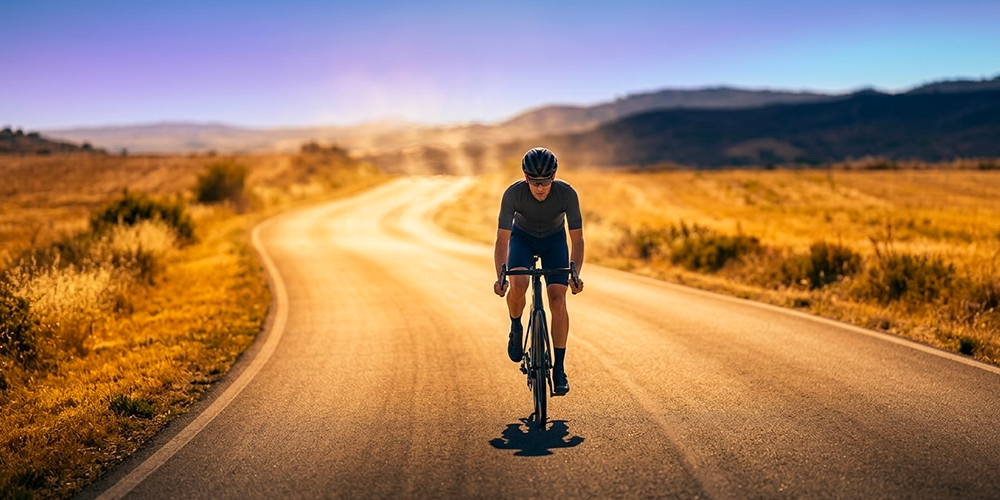
The first summer rides always feel harder than expected. The legs are there, the lungs too — yet heart rate spikes, pace drops, and after half an hour you feel completely drained.
It’s not a fitness issue. It’s that your body has never been trained to work under thermal stress. The good news is that this feeling is temporary. With about two weeks of gradual exposure — and a few practical adjustments — the body adapts remarkably well.
What happens to the body in the heat
When you train in high temperatures, your cardiovascular system has to do two things at once: deliver blood to the working muscles, and deliver blood to the skin to dissipate heat. These two demands compete for the same resources, and the result is that heart rate rises even though the effort level is the same as usual.
At the same time, core body temperature rises more quickly than during a session in cool conditions. The body, to protect itself, starts slowing you down before you even notice — this is a safety mechanism, not a weakness. For many athletes not yet accustomed to summer heat, sustainable power output drops by 10–15% compared to cooler days.
The body adapts — and does so quickly
The interesting part is that just a few weeks of regular training in the heat are enough for the body to adapt significantly. Science has documented these changes with considerable precision: plasma volume — the liquid portion of the blood — increases by an average of 6–12% after a period of heat exposure (Carr et al., 2019, Frontiers in Physiology). This means the heart can pump more blood per beat, and the body no longer has to choose between cooling the skin and fuelling the muscles — it can do both better.
Other adaptations you’ll notice over time: sweating begins earlier and becomes more abundant, heart rate at the same effort level drops, and the sense of fatigue diminishes. It doesn’t mean heat stops being hot — but your body becomes much more efficient at managing it (Racinais et al., 2015, British Journal of Sports Medicine).
Most of these adaptations occur within the first 10–14 days of regular exposure. In practice, if you start the summer season by training consistently and not skipping sessions to “avoid the heat,” the process happens on its own — no special protocols needed.
How to adapt intelligently
The key is gradualness. There is no safe shortcut to speed up adaptation. In the first two summer weeks, don’t look at watts or pace — focus on how you feel and how your heart rate responds. If your normal pace puts you at 150 bpm in spring, expect to be at 160–165 at the same perceived intensities until the body has adapted. That’s normal. Resisting the temptation to push harder is the smartest choice.
If you have a quality session planned — intervals, threshold work, a demanding long ride — move it to the cooler hours of the day, where you perform better and recover faster. Easy sessions, on the other hand, are the right moment to expose yourself to the heat: that’s where adaptation happens, without compromising training quality.
Those who want to accelerate the process can use deliberate heat acclimatisation sessions: 60–90 minute rides or workouts during the hottest hours of the day at moderate intensity. The goal is not performance, but prolonged exposure to thermal stress — enough to send the body a clear signal without fully depleting it. It’s not mandatory, but can be useful if you have little time before a race in a hot environment or want to compress the adaptation timeline.
Note: these sessions should be approached with caution. Start with shorter exposures, never train alone in extreme heat, and stop if you experience headache, nausea, or dizziness.
Hydration becomes more critical than you might think. In the heat, you can lose between 0.5 and 2 litres of water per hour depending on intensity and temperature. A simple signal to watch: urine colour. Pale straw yellow means you’re well hydrated; dark yellow means you’re building up a deficit. Drink before you’re thirsty, not after.
Warning signs to watch for
Training in the heat requires a more attentive level of body awareness than in cool seasons. Unusual fatigue, headaches during or after a session, nausea, dizziness, or a sudden stop in sweating are signs that the body is struggling to regulate temperature: in these cases, stop, seek shade and cool air, rehydrate, and don’t resume until you feel well.
People with cardiovascular problems, high blood pressure, or taking medications that affect thermoregulation (certain diuretics or beta-blockers, for example) should consult their doctor before increasing training load in the warmer months.
Summer heat as a stimulus, not an obstacle
Something that surprises many athletes is learning that training in the heat doesn’t only improve performance in hot conditions. The increase in plasma volume — one of the main adaptations — also brings benefits in races held in cool conditions or at altitude, because it improves the blood’s ability to transport oxygen (Chalmers et al., 2019, Frontiers in Physiology). In other words, summer weeks, when managed well, build a solid physiological base for the entire second half of the season.
References
Racinais S. et al. (2015). Consensus recommendations on training and competing in the heat. British Journal of Sports Medicine, 49(18), 1164–1173.
Carr A.J. et al. (2019). Mixed Active and Passive, Heart Rate-Controlled Heat Acclimation Is Effective for Paralympic and Able-Bodied Triathletes. Frontiers in Physiology, 10, 1214.
Chalmers S. et al. (2019). Performance Changes Following Heat Acclimation and the Factors That Influence These Changes: Meta-Analysis and Meta-Regression. Frontiers in Physiology, 10, 1448.