
Starting spring training without knowing your current fitness level is like navigating without a compass. A well-executed performance test at the beginning of the season allows you to calibrate your training zones, measure your progress compared to the previous year, and avoid burning out on sessions that are too intense too early. Here are the essential tests by discipline.
Why test at the start of the season?
Winter changes your fitness level — for better or worse, depending on how consistently you trained during the base phase. The intensity zones calculated in October are probably no longer valid in March. Training on outdated data means risking under-loading your easy sessions (and therefore recovering poorly) or overestimating your capacity during intervals (and therefore accumulating fatigue without any benefit). A test resets the counters and gives the 2PEAK algorithm the data it needs to build a precise, tailored plan.
Note: avoid performing the performance test during the week of the clock change. These are not the most favourable days, as your circadian rhythm may not yet have stabilised.
2PEAK performance test overview
Cycling: the MP climb test or the Time Trial
In cycling, performance cannot be measured by speed alone — wind, elevation, and aerodynamics distort the picture too much. Power is the only reliable unit.
Without a power meter: the MP climb test. The 2PEAK MP (Maximum Power) test is performed on a climb with at least 7% gradient. Using the difference in altitude, total weight (body + bike + equipment), and time, 2PEAK calculates the power output with great accuracy. The recommended duration is at least 4 minutes, ideally 8 minutes or more, to obtain a value representative of aerobic capacity.
With a power meter: the Time Trial Test. If you have a power meter, the Time Trial Test allows you to directly enter your average power over a sustained maximal effort. It is the equivalent of the classic FTP test, directly integrated into 2PEAK.
Protocol in practice:
- Perform the test after a recovery phase, not at the end of a heavy training week
- Warm up for 20 minutes at base endurance pace (zone 2)
- Cross the start line already in motion (flying start), then maintain a steady, maximal effort all the way to the finish
- Do not test in strong wind or extreme heat

Running: the MAS test
In running, air resistance is negligible, making speed a reliable performance indicator. 2PEAK uses MAS (Maximum Aerobic Speed) to define pace zones.
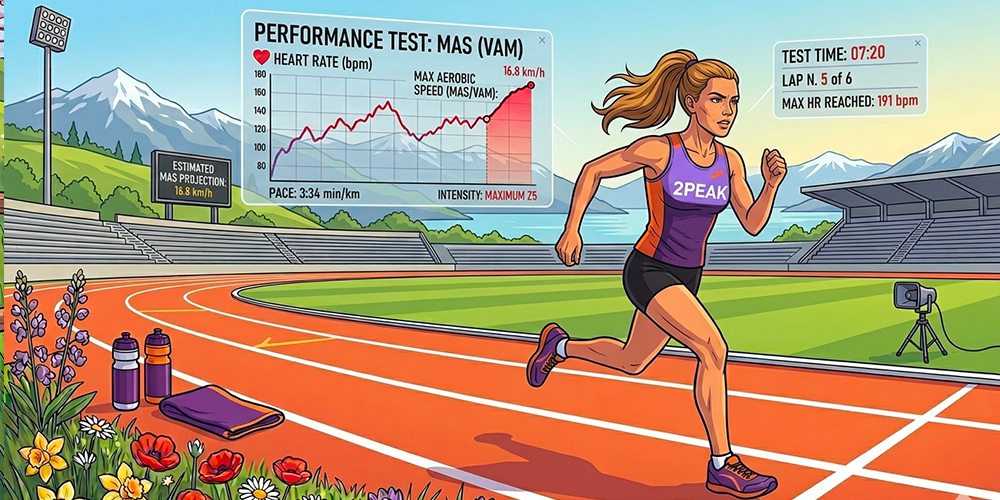
The 2PEAK MAS test is run over 2000 m — or 3000 m if you can cover the 2000 m in under 7 minutes 30 seconds. Ideally on an athletics track, but a flat, measured course works just as well. After a warm-up of at least 20 minutes, start at around 90% of your perceived maximum speed and save the full 100% for the final lap. Enter your time and your maximum heart rate reached — 2PEAK will calculate your pace zones from these two values.
Tips for a reliable test:
- Choose a flat course, ideally an athletics track
- Neutral conditions: no extreme heat or strong wind
- Reproduce exactly the same protocol at each test in order to compare results over time
Swimming: the CSS test
For triathletes, swimming is often the least well-calibrated discipline. CSS (Critical Swim Speed) corresponds to your threshold pace in swimming — the speed you could sustain over a 1500 m time trial. This is the reference from which 2PEAK calculates your pool training zones.
The test consists of two efforts in the same session. After a thorough warm-up, swim a 400 m all-out and record your time. After 5 to 10 minutes of active recovery, follow it with a 200 m all-out. Check that your pace per 100 m is faster on the 200 m than on the 400 m: for example, if you swim the 400 m in 6’00” (i.e. 1’30″/100 m), your 200 m must be completed in under 3’00” (i.e. faster than 1’30″/100 m).
If that is not the case, one of the two efforts was not properly paced — most likely a too-fast start on the 400 m or a too-conservative effort on the 200 m — and it will be best to redo the test. 2PEAK derives your threshold speed from the time difference between the two distances. Enter the results into the 2PEAK CSS tool to calibrate your zones.

Triathlon: test all three disciplines, but not at the same time
For a triathlete, the ideal is to test all three disciplines at the start of the season — but not in the same week. A performance test is a maximal effort: it generates significant fatigue and requires 48 to 72 hours of recovery before returning to a normal training load.
Suggested schedule:
- Week 1: cycling test (MP or Time Trial)
- Week 2: swimming test (CSS)
- Week 3: running test (MAS)
This allows enough time to recover properly between each effort and to integrate the new data into the 2PEAK plan before the specificity blocks begin.
When should you repeat the tests?
2PEAK flags the ideal moment to perform a new test on your calendar according to your discipline. As a general rule, a test every 6 to 8 weeks allows you to track progress and adjust your zones throughout the season. Short-duration tests (anaerobic power) are useful for sprint specialists, criterium riders, or cross-country mountain bikers; longer-duration tests (8 minutes and above) are most relevant for endurance athletes.
In summary
A well-executed test at the start of the season is the best investment you can make before entering the first weeks of training load. It gives 2PEAK the data it needs to build a truly personalised plan — and gives you an objective baseline to measure your progress throughout the season.