
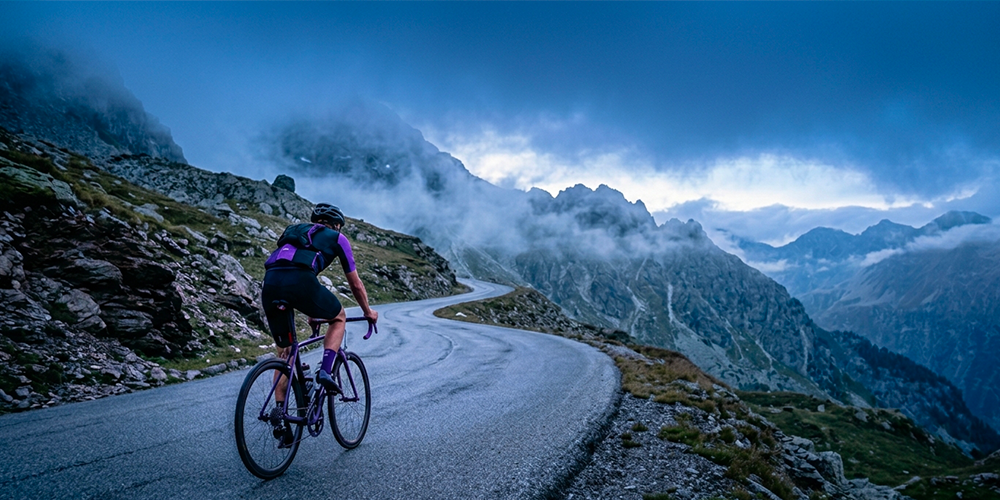
A granfondo is decided long before the final kilometres. It is the first ones — those filled with euphoria, where the legs spin smoothly and the group carries you along — that build (or undermine) everything that follows.
A granfondo is a challenge of its own kind. It is not a time trial, where you can push flat out for an hour knowing it will be over soon. It is not a leisurely ride either, where you can listen to your body and ease off whenever you like. It sits somewhere in between: a real race, with a demanding course, significant climbing, and a duration that — depending on your level — can range from 3 to 7–8 hours. And poor race management, as a rule, makes itself felt.
What follows is a guide to approaching the race from a strategic perspective: pacing, nutrition, the climbs, and how to manage the final kilometres. There is no magic formula, but there are principles that physiology supports fairly clearly.
Pacing: the mistake almost everyone makes
The reason going out too fast is so common is simple: at the start, it does not hurt. The legs are fresh, the race carries you, the adrenaline does its job. The problem is that the body has limited energy reserves — particularly muscle glycogen, the form of carbohydrate that muscles use to produce energy at high intensity — and if you burn through them too early, you do not get them back.
Abbiss and Laursen, in a 2008 review published in Sports Medicine, classified different pacing strategies in endurance sports and concluded that excessive early-race effort — known as positive pacing — tends to significantly reduce overall performance. For events lasting more than 60–90 minutes, a more even or slightly increasing effort distribution (even pacing or negative split) is generally associated with better results.
In practice: in the first half of a granfondo, you should almost feel frustrated by how slowly you are going. If you are already suffering 30 km from the start, you are probably doing too much.
If you have a power meter, a practical reference is to stay between 65% and 75% of your FTP (Functional Threshold Power — the average maximum power you can sustain for approximately one hour) on flat and rolling sections. If you ride by heart rate, aim for zone 2–3: you can still speak in full sentences, but it is not a walk in the park.
The climbs: where the day is decided
In granfondos with significant elevation gain, the climbs are the most critical moment. This is where the group splinters, where the temptation to follow faster riders is strongest, and where the most costly mistakes are made.
The basic rule: never go anaerobic (that is, above the lactate threshold) on climbs in the first two-thirds of the race, unless it is absolutely necessary to avoid losing your reference group. Once you exceed the threshold, lactate accumulates faster than it can be cleared, and the resulting fatigue requires time to recover from — time you do not have in a race.
On long climbs, it is better to start at a pace you know you can hold to the summit. A classic mistake is to push hard in the lower section when the gradient is still manageable, only to be forced into a sharp slowdown in the upper part. The effect on muscular economy is considerably worse than if you had ridden at a steady pace from the outset.
With a power meter, a practical reference for long climbs (15–30 minutes): keep your power between 75% and 85% of FTP. On shorter climbs you can raise the effort, but set yourself a clear ceiling before you begin.
Eat before you are hungry
In-race nutrition is one of the most underestimated aspects of granfondo riding, especially among amateurs. The problem is that the hunger signal arrives later than the actual state of glycogen depletion. By the time you feel the infamous “bonk”, muscle glycogen has already dropped to levels that compromise performance.
Jeukendrup, in a 2014 article in Sports Medicine, synthesised decades of research on nutrition during prolonged exercise, indicating that for efforts lasting more than 60 minutes, carbohydrate intake should be between 30 and 90 grams per hour — with the higher values justified for efforts exceeding 2.5–3 hours. The gut has a limited absorption capacity, and reaching 90 g/h requires combining different types of carbohydrate (glucose and fructose), which most modern sports gels and bars already do.
In practice: start eating within the first 30–45 minutes of the race, without waiting to feel empty. One gel every 30–40 minutes, supplemented by something more solid in the early hours (a banana, dates, a chewable bar), is a sensible strategy for most athletes. The final two hours of a granfondo are notoriously hard for those who neglected nutrition in the early stages: legs that “run dry” are not always a muscular problem — they are often a fuel problem.
One practical detail that makes a real difference: test your nutrition strategy on long training rides, not on race day. Every stomach responds differently to food under effort, and finding that out during a race is a risk not worth taking.
Drink before you are thirsty
The same reasoning applies to hydration. Thirst is a signal that arrives once dehydration is already under way — even a fluid loss of just 2% of body weight produces a measurable drop in aerobic performance (Sawka et al., 2007, Medicine & Science in Sports & Exercise).
In summer granfondos or in warm conditions, the goal is to drink regularly from the start: around 400–800 ml per hour, depending on temperature and individual sweat rate. At feed stations, always top up — even if you do not feel the need in the moment. Leave with full bottles.
One point many overlook: electrolytes. Prolonged sweating means sodium loss, not just water loss. Drinking only water during very long efforts may not be sufficient — which is why many sports drinks contain sodium, and using salt tablets or mineral capsules makes sense in races exceeding 3–4 hours.
The final kilometres: when you can push
If you have managed the earlier phases of the race well, the last 20–30 km should be the moment when you can finally raise the pace. You still have fuel in reserve, the legs respond, and your mind knows the finish is close. This is the negative split in its most concrete form: you arrive in the final third of the race stronger than you started.
If, on the other hand, you are already suffering at the halfway point, the strategy shifts: the goal becomes damage control, not increasing speed. Slow down, eat something, drink. An athlete who finishes a granfondo consistently — even slower than planned — learns more than one who storms off the start and ends up walking the final climbs.
There is no universal end-race strategy. It depends on the course, your condition on the day, how much you pushed on the climbs. But one principle always holds: do not burn your last reserves 40 km from the finish line believing you can hold on. Know your body, respect the signals, and keep something back for when it really counts.
A few words on warming up
For longer granfondos (more than 4–5 hours), a formal warm-up is not always practical — nor always necessary. The course itself almost always offers a flatter initial section that serves as a natural warm-up. What matters is resisting the temptation to force the opening kilometres just because the legs feel fresh: they feel fresh because you have not been riding long enough yet to feel acute fatigue.
For shorter granfondos, or for athletes targeting a specific time, 15–20 minutes of easy spinning before the start — where possible — helps the cardiovascular system adapt and reduces the risk of going out too hard to compensate for “cold” legs.
In summary
A well-ridden granfondo is not remembered for how you started, but for how you finished. Race strategy is not a luxury reserved for professionals — it is a tool anyone can learn to use, and it makes the difference between a satisfying race and one you finish with the regret of not having managed your effort better.
Know your FTP or threshold heart rate, plan your nutrition in advance, respect your pace on the climbs, and save your final reserves for the end. It is not the most thrilling tactic — but it is the one that works.
Sources
- Abbiss CR, Laursen PB. (2008). Describing and understanding pacing strategies during athletic competition. Sports Medicine, 38(3), 239–252.
- Jeukendrup AE. (2014). A step towards personalized sports nutrition: carbohydrate intake during exercise. Sports Medicine, 44 Suppl 1, S25–33.
- Sawka MN, Burke LM, Eichner ER, Maughan RJ, Montain SJ, Stachenfeld NS. (2007). American College of Sports Medicine position stand: exercise and fluid replacement. Medicine & Science in Sports & Exercise, 39(2), 377–390.
- Thomas DT, Erdman KA, Burke LM. (2016). Position of the Academy of Nutrition and Dietetics, Dietitians of Canada, and the American College of Sports Medicine: Nutrition and Athletic Performance. Journal of the Academy of Nutrition and Dietetics, 116(3), 501–528.